
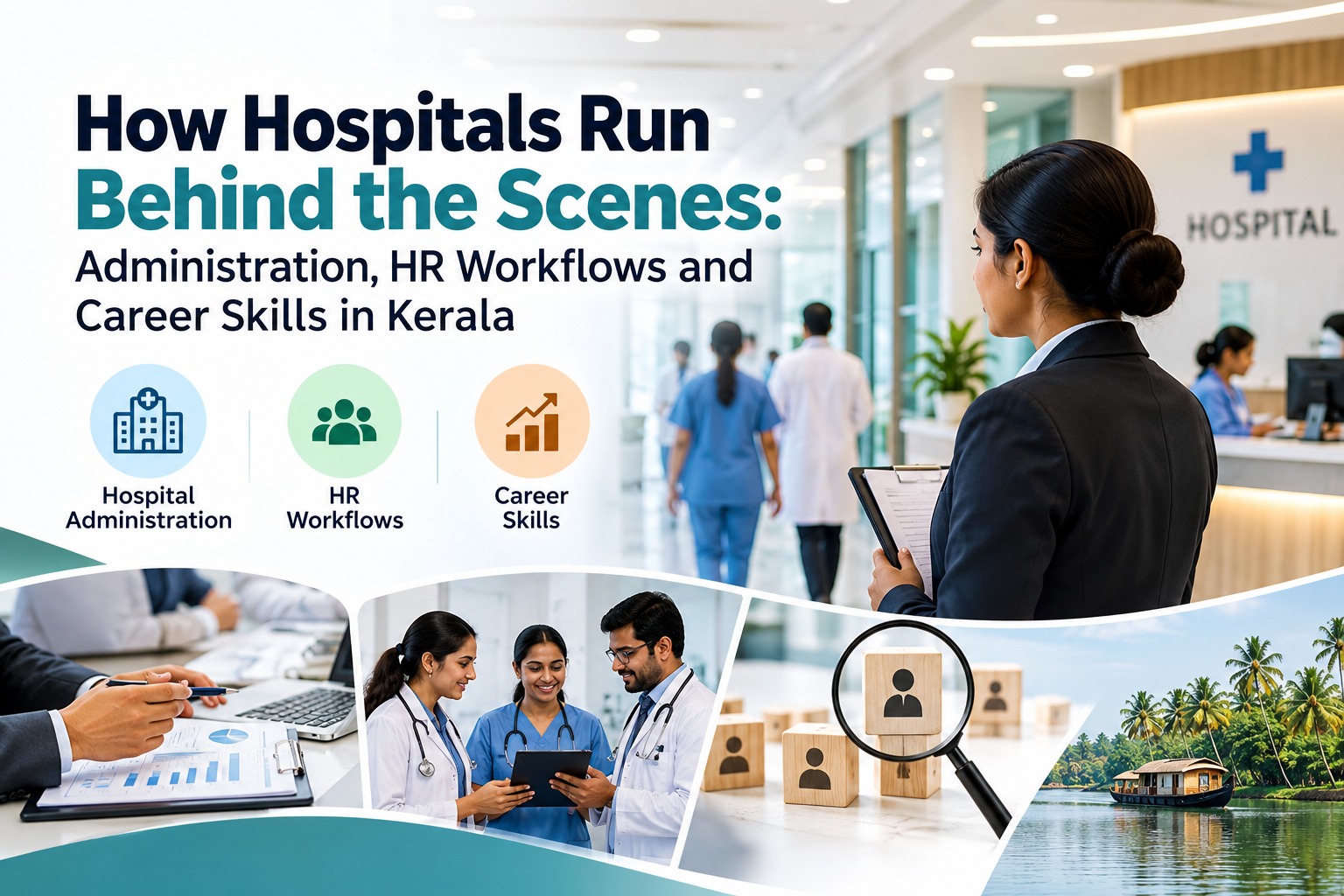

How Hospitals Run Behind the Scenes: Administration, HR Workflows and Career Skills in Kerala
Hospitals are more than doctors, nurses and medical equipment. Every day, multiple teams work behind the scenes to manage patient registrations, appointments, staff schedules, medical records, billing and employee coordination. These administrative processes help healthcare professionals focus on patient care while ensuring that essential services remain organised.
For students, fresh graduates and career changers in Kerala, understanding these workflows can provide a clearer picture of non-clinical opportunities in healthcare. Hospital administration and HR are two important functions that work together to support daily hospital operations.
What Keeps a Hospital Running Beyond Medical Treatment?
Hospital operations involve coordinating different departments so patients can access services efficiently. While doctors and nurses handle clinical assessment and treatment, administrative teams support the processes surrounding patient care.
The front office manages appointments and registration. The outpatient department (OPD) coordinates outpatient services, while the inpatient department (IPD) supports admission-related processes. Billing teams handle payments and documentation, medical records teams maintain authorised patient information, and HR manages workforce-related activities.
Consider a patient visiting a hospital in Kochi. The process may begin with appointment booking and registration, followed by consultation and investigations. If admission is necessary, the relevant departments coordinate the required administrative steps. During discharge, billing, documentation and follow-up instructions must be handled appropriately.
A delay in registration or missing documentation can affect other departments. This is why communication, accurate records and timely coordination are essential hospital administration skills.
Hospital Administration vs Hospital HR: Who Handles What?
Hospital administration focuses on daily operations, service coordination and resource management. Hospital HR focuses on employees, recruitment, onboarding, attendance, training and workforce documentation. Both functions must work together to support smooth hospital operations.
| Hospital administration | Hospital HR |
| Coordinates daily services and workflows | Supports recruitment and onboarding |
| Monitors operational reports and delays | Maintains authorised employee records |
| Coordinates patient-service departments | Supports attendance and staff scheduling |
| Follows up on administrative issues | Coordinates training and employee processes |
For example, if a department experiences a sudden staff shortage, the department head and administration team assess the operational impact. HR helps verify staff availability and coordinate an appropriate replacement through established procedures.
Similarly, when a hospital opens a new department, administration identifies operational requirements while HR supports recruitment and joining formalities. Clinical staffing and patient-care decisions remain the responsibility of authorised clinical leaders.
Real Hospital Workplace Problems and the Skills Needed to Solve Them
Hospital administration and HR professionals encounter practical challenges that require attention to detail and effective communication.
Long patient queues: Front office teams may need to identify registration delays, explain waiting times and coordinate with the relevant department. Communication and prioritisation are important.
Last-minute staff shortages: HR and department supervisors may need to review attendance, check roster availability and arrange authorised coverage. Scheduling and coordination skills help minimise disruption.
Delayed insurance claims: Missing documents or incorrect entries can delay claim processing. Insurance coordinators work with billing and authorised records personnel to identify missing information and follow the correction process.
Patient-record discrepancies: Inconsistent information must be verified and corrected through approved procedures. Accuracy, confidentiality and responsible information handling are essential.
Employee attendance issues: HR may need to compare attendance records with approved schedules and resolve discrepancies before payroll processing. Spreadsheet skills and systematic recordkeeping are useful.
These examples demonstrate that hospital HR management and hospital operations management are closely connected. Both depend on reliable information, clear responsibilities and timely follow-up.
Essential Skills for Hospital Administration and HR Jobs
Beginners do not necessarily need advanced technical knowledge to start learning hospital administration. However, they need a foundation in administrative processes, digital tools and professional communication.
Important skills include:
Documentation: Maintaining accurate records, preparing reports and checking forms.
Computer skills: Using spreadsheets, email and digital recordkeeping tools.
Communication: Responding professionally to patients, colleagues and supervisors.
Coordination: Following up with departments and managing routine administrative tasks.
HR fundamentals: Understanding recruitment tracking, onboarding, attendance and employee records.
Confidentiality: Protecting patient and employee information in accordance with authorised access rules.
Problem-solving: Identifying process gaps and escalating issues appropriately.
A useful starting exercise is to create a fictional appointment register, an employee attendance tracker and a simple daily operations report. These practice tasks help beginners understand documentation and workflow management without using real patient information.
How Hospital Software Changes Daily Administrative Work
Hospitals may use Hospital Information Systems (HIS), electronic medical record systems, billing applications, insurance modules and HR information systems. The available tools differ between organisations.
For example, a paper-based appointment register may require staff to search through multiple pages to find a booking. A digital system may make appointment retrieval and updates easier, provided the information is entered correctly and users have the necessary permissions.
Spreadsheets also support administrative reporting, attendance tracking and routine follow-up. Learning basic data entry, sorting, filtering and report preparation can help beginners become more comfortable with digital workflows.
Technology does not remove the need for accuracy. Hospital employees must follow organisational procedures, use authorised accounts and protect sensitive patient and employee information.
Hospital Administration and HR Career Opportunities in Kerala
People interested in non-clinical healthcare work can explore several entry-level roles, depending on their qualifications and the employer's requirements.
Hospital Administration Executive: Supports operational coordination and administrative reporting.
Front Office Executive: Handles appointments, registration and patient enquiries.
HR Assistant: Supports employee documentation and routine HR activities.
HR Coordinator: Helps organise interviews, onboarding and training schedules.
Patient Relations Executive: Assists with service enquiries and complaint coordination.
Medical Records Assistant: Supports authorised record organisation and retrieval.
Insurance/TPA Coordinator: Follows up on insurance documentation and claim-related processes.
Hospital Operations Coordinator: Helps coordinate activities across departments.
Hospitals, clinics, diagnostic centres and other healthcare organisations may offer different types of administrative and HR roles. In Kochi and across Kerala, candidates should review individual job descriptions carefully instead of assuming every position has the same eligibility criteria.
Those who enjoy interacting with people may prefer front office or patient relations work. Candidates who enjoy documentation may prefer medical records or insurance coordination, while those interested in employee processes may consider HR roles.
How to Prepare for a Hospital Administration or HR Job
A practical preparation plan can help freshers understand workplace expectations before applying.
Learn hospital workflows: Understand registration, OPD, IPD, billing, admission and discharge processes.
Choose a role direction: Identify whether administration, patient services, records, insurance or HR suits your interests.
Build computer skills: Practise spreadsheets, email writing and basic reporting.
Practise realistic tasks: Prepare sample reports, attendance trackers and onboarding checklists using fictional data.
Understand hospital software: Explore demonstrations or training environments when available.
Prepare for interviews: Practise scenario-based questions about communication, documentation, confidentiality and staff coordination.
Apply strategically: Tailor your résumé to entry-level roles and explain your practical skills honestly.
You do not need to misrepresent yourself as an experienced hospital employee. Instead, demonstrate what you understand, what you have practised and how you would approach routine administrative situations.
How to Choose Practical Hospital Administration and HR Training
When comparing training programmes, look beyond the course title. Check whether the curriculum explains hospital workflows, OPD/IPD processes, billing, insurance coordination, HR activities, documentation and relevant software.
Ask whether practical exercises are included, how learners practise workplace scenarios, what support is available for interview preparation and whether any claimed practical exposure or internship is clearly explained.
For students exploring structured learning, Camerin Folks offers a Hospital Administration & HR course. Review the published curriculum and programme details to determine whether the training matches your preferred career direction and learning needs.
The right preparation should help you understand real responsibilities, develop transferable skills and make informed career decisions. A course can support your learning, but employment depends on factors including qualifications, skills, employer requirements and interview performance.
Frequently Asked Questions
1. What does a hospital administrator do?
A hospital administrator supports daily hospital operations, coordinates departments, monitors administrative processes and helps resolve service-related issues.
2. What does an HR professional do in a hospital?
Hospital HR professionals support recruitment, onboarding, employee records, attendance, training coordination and other workforce-related processes.
3. Can non-medical graduates work in hospital administration?
Some administrative and HR roles accept candidates from non-medical educational backgrounds. Eligibility depends on the specific job and employer.
4. What skills are required for hospital administration jobs?
Communication, documentation, computer skills, coordination, problem-solving and confidentiality are useful foundations.
5. What entry-level hospital administration jobs are available in Kerala?
Potential roles include front office executive, hospital administration executive, patient relations executive, medical records assistant and insurance coordinator. Actual vacancies and eligibility vary by employer.
6. What software should a beginner learn?
Start with spreadsheets, email and basic reporting. Familiarity with HIS, electronic medical records, billing or HR systems can be useful, depending on the role.
7. How can a fresher gain practical experience?
Practise realistic administrative tasks with fictional data, explore software demonstrations, undertake relevant supervised training where available and prepare for scenario-based interviews.
8. Start Building Your Healthcare Administration Skills
A hospital depends on more than clinical expertise. Organised workflows, accurate documentation, effective HR processes and responsible technology use all contribute to daily operations.
If you are exploring a healthcare administration career in Kerala, begin by identifying the type of work you enjoy and the skills you need to develop. Explore the Camerin Folks Hospital Administration & HR programme to review the curriculum and consider whether it aligns with your learning goals.




 How can I help you?