
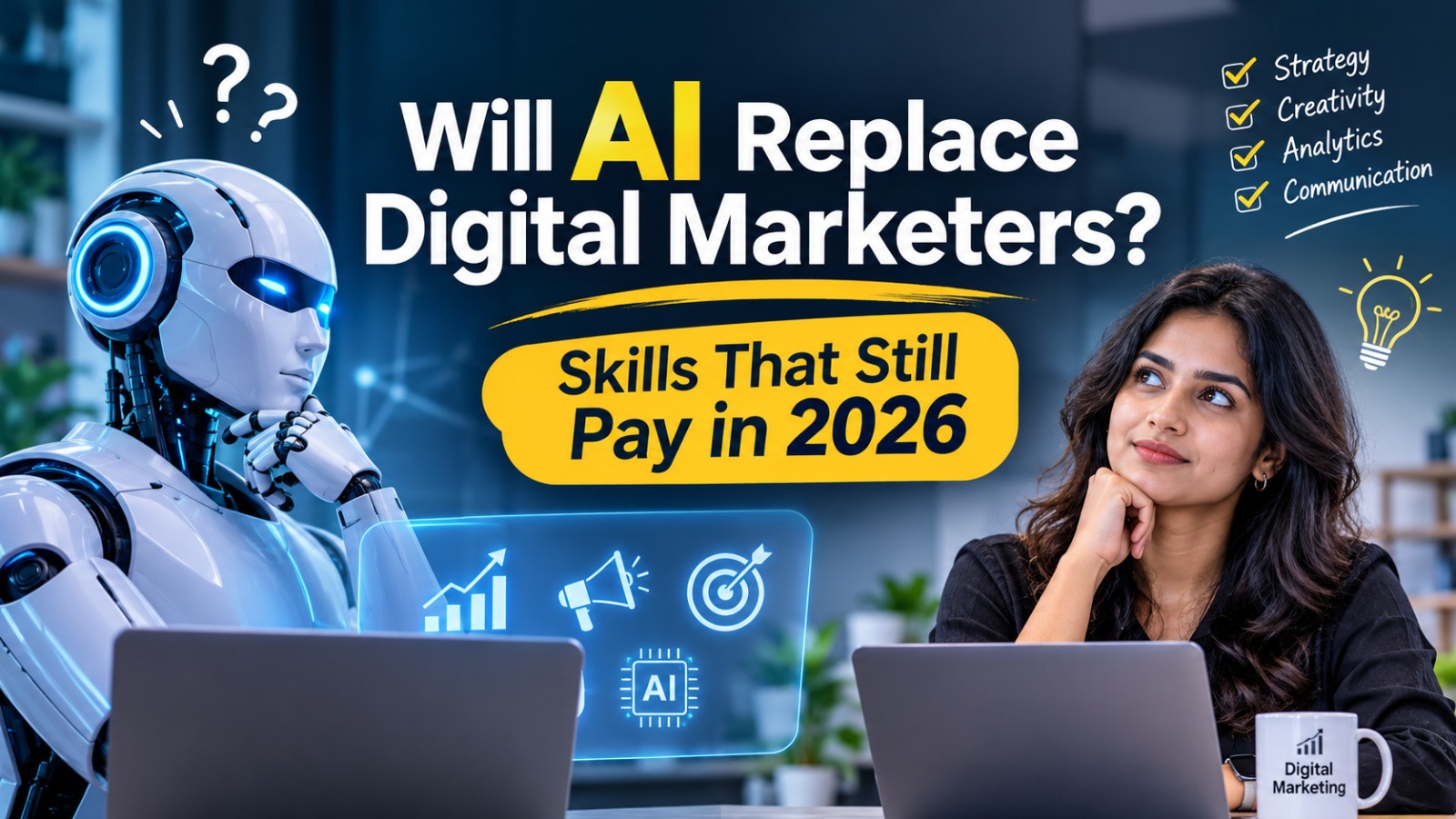

Will AI Replace Digital Marketers? Skills That Still Pay in 2026
AI can now write social media captions, create advertisements, suggest keywords and prepare marketing reports in seconds. This has created a common concern among students and working professionals: will AI replace digital marketers?
The honest answer is that AI is changing digital marketing, but it is not removing the need for skilled marketers. Routine work is becoming automated. Strategy, creativity, business understanding and decision-making still need human involvement. The real opportunity is learning how to work with AI.
Will AI replace digital marketers?
AI is more likely to replace repetitive marketing tasks than the entire digital marketing profession. It can generate content, analyse information and support campaign execution. However, businesses still need people who understand customers, set marketing goals and make decisions based on actual results.
Think about a company launching a new product. AI can suggest advertisements and social media content. But someone must understand the target audience, decide the campaign budget, select the right platform and evaluate whether the campaign generates sales.
These responsibilities require more than generating text.
Digital marketing is also not one single job. It includes SEO specialists, performance marketers, content strategists, social media managers, email marketers and marketing analysts. Each role involves different responsibilities.
AI may change how these professionals work. Some tasks may require fewer manual hours. New responsibilities may also emerge around AI-assisted search, automation and data analysis.
Therefore, the important question is not whether AI will replace every marketer. It is whether marketers are developing the skills needed to work effectively in an AI-driven environment.
Which digital marketing tasks is AI taking over?
AI is already useful for tasks that involve repetitive processes, pattern recognition and first-draft creation. Marketers can complete many routine activities faster with the right tools.
However, faster execution does not always mean better marketing. Human review remains important.
| Marketing task | AI's impact | What still needs human input |
| Basic content writing | Creates captions, outlines and first drafts | Brand voice, originality and fact-checking |
| Keyword research | Suggests keywords and search topics | Search intent and business relevance |
| Marketing reports | Summarises campaign data | Interpretation and business decisions |
| Ad variations | Generates multiple headline and copy options | Audience selection and campaign strategy |
| Social media planning | Suggests calendars and post ideas | Brand identity and audience understanding |
| Email marketing | Drafts subject lines and email content | Segmentation, timing and customer relationships |
| Competitor research | Collects and summarises available information | Competitive positioning and strategic decisions |
Consider a simple example.
A digital marketer needs to prepare ten social media captions for a new product. An AI writing assistant can generate initial versions quickly. The marketer must still check the product details, correct unsuitable claims and make the captions relevant to the intended audience.
The same principle applies to paid advertising. AI can suggest different advertisements, but marketers must decide which audience to target and how much to spend.
AI helps with execution. Marketers remain responsible for the decisions and results.
Which digital marketing skills still pay in 2026?
The most valuable digital marketing skills 2026 are not limited to operating software. Employers need people who can combine marketing knowledge, analytical thinking and AI-assisted execution.
Here are seven important areas to develop.
1. Digital marketing strategy
Strategy is about understanding business goals and selecting the right marketing activities.
A business may want more website visitors, product enquiries or online sales. Each goal needs a different approach.
Marketers must understand the customer journey, audience behaviour, competition and available budget. AI can provide suggestions, but the marketer must choose a suitable direction.
2. Data analytics and interpretation
Marketing decisions should be supported by data.
Learn how to understand website traffic, conversion rates, engagement, click-through rates and campaign performance. Tools such as Google Analytics 4 and Google Search Console help marketers study website and search performance.
The important skill is not simply generating reports. It is identifying what the numbers mean and deciding what to improve.
3. Paid advertising and campaign management
Google Ads and Meta Ads remain important areas of digital marketing.
AI can assist with audience suggestions, creative variations and campaign insights. However, marketers must understand campaign objectives, budgets, targeting, bidding, lead quality and return on advertising spend.
A campaign receiving many clicks may still fail to generate useful enquiries. Understanding this difference is essential.
4. Brand communication and storytelling
Customers connect with brands through messages, experiences and trust.
AI can produce content, but generic content may not communicate a company's unique identity. Marketers need to understand tone, storytelling, customer problems and brand positioning.
Good communication makes marketing more meaningful.
5. Conversion rate optimisation
Getting visitors to a website is only one part of marketing. Businesses also want visitors to take action.
Conversion rate optimisation involves improving landing pages, calls to action, website content and customer journeys.
Marketers must identify where visitors leave and test possible improvements. AI can support analysis, but understanding customer behaviour is essential.
6. AI workflow design and automation
Knowing how to use AI tools is becoming an important professional advantage.
Learn to write effective prompts, review AI outputs, connect repetitive tasks and create useful workflows. Understand where automation saves time and where human approval is necessary.
The goal is not to use AI for everything. It is to use it where it creates genuine value.
7. AEO and GEO
Search behaviour is changing. People increasingly use AI-powered search experiences to discover information and compare businesses.
Answer Engine Optimisation (AEO) and Generative Engine Optimisation (GEO) are useful areas to understand alongside traditional SEO.
Marketers should learn how to create clear, useful, well-supported content that answers real questions. They should also understand how to monitor brand visibility across different search experiences.
Is SEO dead? What are AEO and GEO?
No. SEO is not dead. It remains an important foundation for traditional search and AI-powered search experiences.
SEO, AEO and GEO have related goals, but they focus on different ways people discover information.
| Approach | Meaning | Main objective |
| SEO | Search Engine Optimisation | Improve visibility in search engine results |
| AEO | Answer Engine Optimisation | Make information easy for answer engines to understand and use |
| GEO | Generative Engine Optimisation | Improve the chances of a brand or its information being referenced in generative AI responses |
For example, imagine someone searching for a digital marketing course in Kochi.
Traditional SEO helps a relevant course page appear in search results. AEO encourages clear answers to questions such as course duration and syllabus. GEO focuses on making reliable brand and course information discoverable and useful within AI-generated responses.
These approaches should not be treated as replacements for one another.
Google's official guidance confirms that existing SEO fundamentals remain relevant to AI Overviews and AI Mode. Pages should be accessible, useful, technically eligible and supported by reliable content. Google also says there are no additional special technical requirements for appearing in these AI features.
This means marketers should focus on quality rather than shortcuts.
Read: Google's official guide to AI features and your website.
Which AI tools should a marketer learn first?
You do not need to learn every new AI application available. Start with tools that support the main activities of digital marketing.
Consider these four categories:
Writing assistants: Help with content outlines, captions, email drafts, research summaries and campaign ideas. Always check facts and brand tone.
Analytics tools: Help marketers understand website traffic, customer behaviour and campaign performance. Learn to interpret the data instead of depending only on automated summaries.
Design tools: Support the creation of social media graphics, advertisements, presentations and other marketing creatives. Learn basic design principles as well.
Automation tools: Connect repetitive activities, organise workflows and reduce manual work. Understand the process before automating it.
Start with one tool in each category. Practise using it for an actual marketing task. Compare the output with your own work and identify where human corrections are needed.
Tool knowledge becomes more valuable when it is connected to practical marketing skills.
How do you build an AI-ready marketing portfolio?
A portfolio gives employers evidence of what you can actually do. A certificate shows that you completed learning. A practical portfolio demonstrates how you apply that knowledge.
Start by creating three or four small case studies.
Case study 1: SEO project
Select a website and perform keyword research, basic on-page analysis and content recommendations. Explain the issues you identified and the changes you suggested.
Case study 2: Social media campaign
Choose a business and prepare a content calendar, sample creatives and captions. Explain your target audience and campaign objective.
Case study 3: Paid advertising plan
Create a sample Google Ads or Meta Ads campaign plan. Include the objective, audience, advertisement concept, budget assumptions and performance measures. Clearly identify it as a sample if it was not actually run.
Case study 4: AI search visibility test
Select a local business. Ask ChatGPT, Google AI Mode and Perplexity the same three questions. Record whether the business appears in the answers. Make a useful content improvement and repeat the test after a few weeks.
Record screenshots and dates. Results can change across platforms and testing sessions, so do not present a small experiment as proof of ranking improvement.
You can also read our upcoming guide: [How to Build a Portfolio That Gets You Shortlisted in Kochi – PENDING INTERNAL LINK].
What do employers in Kochi look for in a marketer now?
A quick review of digital marketing job descriptions on Infopark's careers portal and Indeed on 26 November 2026 shows that employers expect a combination of practical and analytical skills.
The sample reviewed included ten relevant Infopark listings and additional Kochi job listings. This is a snapshot, not a complete count of available vacancies.
Some recurring requirements included:
SEO, including keyword research, on-page, off-page and technical SEO.
Google Ads and Meta Ads campaign management.
Google Analytics 4 and Google Search Console.
Content creation, copywriting and social media management.
Lead generation, campaign optimisation and performance reporting.
WordPress and basic website management.
Communication, creativity and analytical thinking.
Familiarity with AI tools and emerging search concepts in some roles.
Some Infopark listings also mention AEO, GEO and AI search optimisation as relevant skills. This shows that employers are beginning to consider AI-driven search visibility alongside traditional marketing activities.
For freshers, a strong starting point is to understand the fundamentals and build practical projects. Employers may assess your ability to explain your work, understand campaign objectives and interpret results.
Review the Infopark careers portal and Indeed Kochi job listings for updated opportunities.
What does this mean for someone starting a digital marketing career?
You do not need to become an AI expert before entering digital marketing. You need to understand the fundamentals and develop the ability to use new tools responsibly.
A beginner can start with SEO, social media marketing, content creation and basic analytics. Next, learn paid advertising and campaign measurement. Then practise using AI writing assistants, analytics support and automation workflows.
Try to complete projects that combine these skills.
For example, you could select a local business and prepare a simple digital marketing plan. Identify its target audience, research relevant keywords, create a content calendar and suggest an advertising strategy. Use AI to support research and drafting, but explain your own decisions.
This approach helps you develop confidence and gives you useful material for interviews.
[PENDING – Camerin trainer interview input:] Add a short trainer quote explaining which AI tasks are used in real campaigns, where AI makes mistakes and which skills are most important when evaluating junior marketers.
Where can you learn AI-integrated digital marketing in Kochi?
Learning digital marketing requires more than understanding definitions and watching tutorials. Students should practise SEO, content creation, paid advertising, analytics and campaign planning.
They should also learn how AI tools can support these activities without replacing professional judgment.
At Camerin Folks, the AI Integrated Digital Marketing course is structured as a four-month programme with two hours of training on weekdays, according to the published course information.
The programme covers areas including SEO, SEM, social media marketing and content marketing.
If you are comparing options for the Best digital marketing course in Kochi, look beyond the course name. Check the actual syllabus, practical activities, trainer guidance and opportunities to develop a portfolio.
Explore the AI Integrated Digital Marketing course in Kochi to review the programme details.
Your goal should be to become a marketer who understands business objectives, uses data to make decisions and knows how to work with AI tools.
AI is changing the way marketing work gets done. Developing the right skills will help you adapt to that change.
Frequently Asked Questions
1. Is digital marketing a good career in 2026?
Yes, digital marketing can be a good career for people who continue learning. Businesses need professionals who understand analytics, paid advertising, content strategy, SEO and AI tools. Routine tasks are becoming automated, so practical skills, decision-making and measurable campaign results are increasingly important.
2. Can ChatGPT replace an SEO specialist?
No, ChatGPT cannot independently take responsibility for an entire SEO strategy. It can support keyword research, content drafting and research summaries. However, SEO specialists still need to understand technical issues, search intent, website performance, business goals and the impact of optimisation decisions.
3. What is the difference between SEO, AEO and GEO?
SEO focuses on improving visibility in search engine results. AEO focuses on making information suitable for direct answers from answer engines. GEO focuses on improving brand visibility in generative AI responses. These approaches complement one another and share a foundation in useful, accessible content.
4. Do I need to code to be a digital marketer?
No, programming is not a starting requirement for most digital marketing roles. However, knowledge of analytics, spreadsheets, tracking and website management is useful. Basic HTML, simple scripting and automation can provide additional advantages as you gain experience.
5. How long does it take to learn AI-integrated digital marketing?
You can learn the fundamentals through a few months of structured training and guided practice. Camerin Folks publishes a four-month AI Integrated Digital Marketing programme. However, becoming skilled requires continued practice, campaign experience and learning as tools and platforms change.


 How can I help you?