
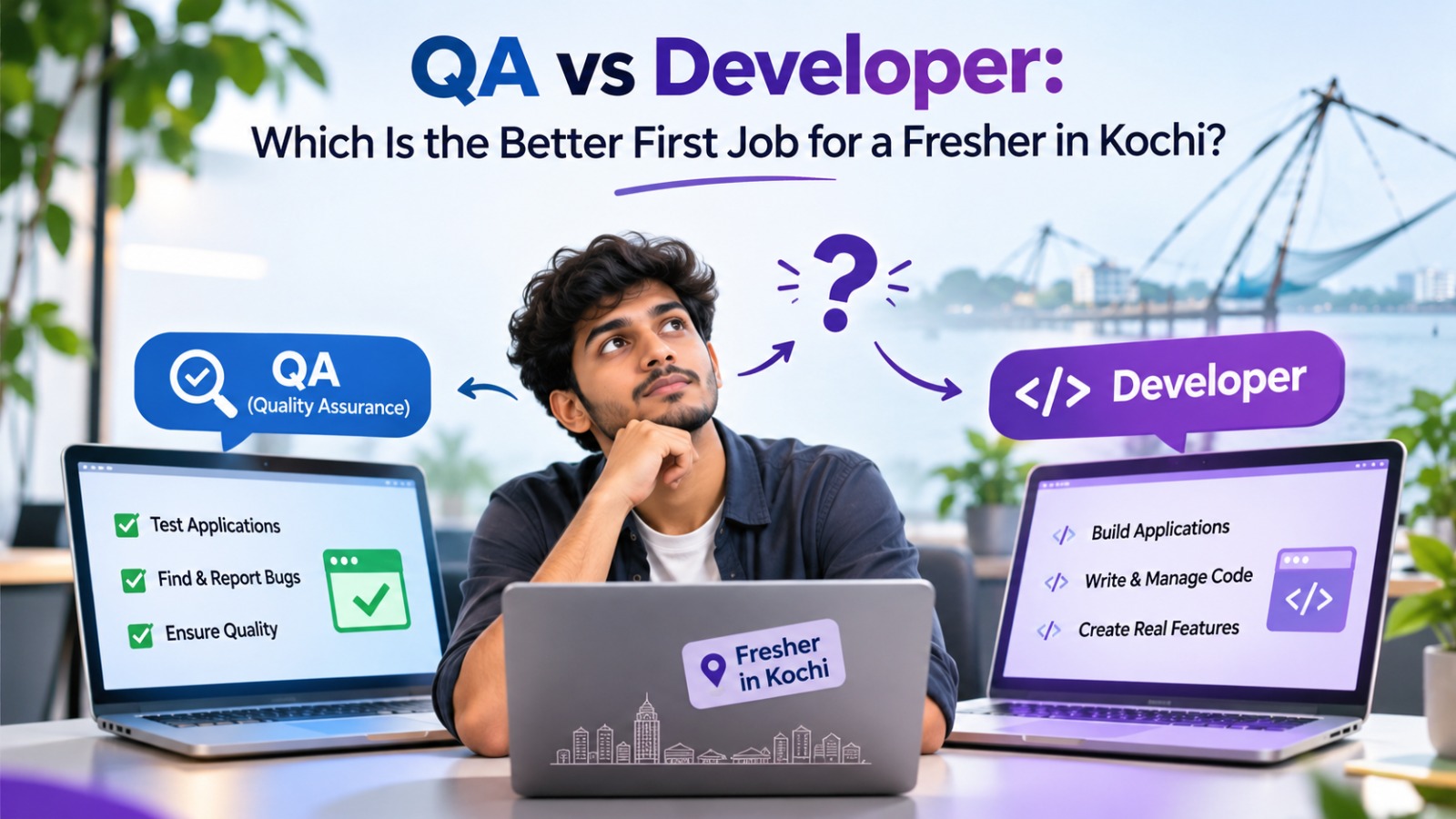

QA vs Developer: Which Is the Better First Job for a Fresher in Kochi?
Choosing your first IT job can feel confusing. Should you become a software tester or a developer? Both careers offer opportunities, but their daily responsibilities differ.
The QA vs developer decision depends on your interests, technical skills and long-term goals. Freshers in Kochi often compare these roles before choosing a training course.
This guide explains the differences, skills, career growth and hiring expectations. It also helps you decide which path suits your strengths.
QA vs Developer: Which Is Better for a Fresher?
Neither role is better for everyone. Developers build software and need strong programming skills. QA engineers assess software quality and identify issues before users encounter them. QA may suit beginners who enjoy structured problem-solving, while development suits those who enjoy coding and building applications. Choose based on your interests, not assumptions about difficulty.
What Is the Real Difference Between a QA Engineer and a Developer?
A software developer creates applications, features and technical solutions. A QA engineer checks whether those applications work correctly and meet requirements.
Both roles work together throughout the software development lifecycle. Their responsibilities are different, but they share the goal of delivering reliable software.
What does a software developer do?
Developers write code to build websites, applications and software systems.
Their daily responsibilities may include:
Understanding project requirements.
Writing and maintaining code.
Building frontend and backend features.
Debugging programming errors.
Reviewing code with teammates.
Working with databases and APIs.
Improving application performance.
For example, a developer might create a login page. They write the code, connect it to a database and ensure users can log in.
Developers need logical thinking, programming knowledge and patience. They must also understand how different application components work together.
What does a QA engineer do?
Quality Assurance engineers evaluate software before release. Their responsibility is to identify defects and help teams maintain quality.
Their daily responsibilities may include:
Understanding software requirements.
Creating test scenarios and test cases.
Testing application features.
Identifying unexpected behaviour.
Reporting bugs clearly.
Retesting corrected defects.
Performing regression testing.
Supporting automation testing.
For example, a QA engineer tests the login page created by a developer.
They check valid credentials, incorrect passwords, empty fields and other situations. If something fails, they document the issue for developers.
QA engineers need analytical thinking, attention to detail and communication skills.
QA vs Developer: How Do These Careers Compare?
The following table gives a practical comparison for freshers.
| Factor | QA Engineer | Software Developer |
| Main responsibility | Check software quality | Build software |
| Daily activities | Testing, documentation, bug reporting | Coding, debugging, feature development |
| Coding requirements | Depends on role; automation requires coding | Core requirement |
| Beginner skills | Testing concepts, logical thinking | Programming fundamentals |
| Technical tools | Testing tools, APIs, automation frameworks | Programming languages, IDEs, databases |
| Entry difficulty | Depends on company requirements | Depends on coding and project expectations |
| Growth | Automation QA, QA Lead, Quality Manager | Senior Developer, Tech Lead, Architect |
| AI impact | Testing workflows are changing | Coding workflows are changing |
| Interview focus | Testing concepts, scenarios, tools | Coding, logic, programming concepts |
Important: This comparison describes common responsibilities. Individual companies may combine testing and development tasks.
Neither career guarantees an easier interview or faster employment.
Which Is Easier to Get Hired for as a Fresher in Kochi?
There is no reliable universal answer. Hiring depends on company requirements, vacancies, skills and competition.
A quick hiring snapshot helps explain why freshers should examine individual job descriptions.
Kochi hiring snapshot
Checked on: 9 November 2026
The Infopark careers listings reviewed included:
Junior and entry-level developer opportunities.
Software engineering positions requiring experience.
A Test Engineer listing at White Rabbit Group.
QA-related positions with experience requirements.
The Infopark job board lists openings across its campuses. Individual vacancies have different experience and skill requirements. https://infopark.in/companies-job/infopark-kochi-phase-1 https://infopark.in/companies-job/infopark-kochi-phase-2?page=2.
An additional entry-level job search on IPSR Jobs showed developer trainee openings at Apps Team Technologies and junior developer opportunities at Panashi FZCO Technology Solutions. These listings requested programming fundamentals and related technical knowledge. https://www.ipsrjobs.com/.
What does this mean for freshers?
The snapshot does not establish that QA or development has more openings overall.
It shows that entry-level opportunities can exist in development, while QA vacancies may have different experience requirements.
Verified opening counts:
Do not select a career based only on the number of advertisements.
Instead, check:
Whether the position accepts freshers.
Whether experience is mandatory.
Which programming languages are required.
Whether projects or internships are expected.
Whether the company provides training.
Whether the position matches your current skills.
Job listings change frequently. Always check the latest requirements before applying.
Is Manual Testing Still a Good Career in the AI Era?
Manual testing remains useful for understanding software behaviour, evaluating usability and identifying unexpected problems.
However, learning only manual testing may limit your opportunities as testing workflows increasingly include automation and AI-assisted tools.
Modern QA professionals benefit from understanding both testing fundamentals and technical tools.
What should aspiring QA professionals learn?
Start with:
Software testing fundamentals.
Software Development Life Cycle (SDLC).
Software Testing Life Cycle (STLC).
Test case preparation.
Bug reporting and defect tracking.
API testing fundamentals.
Automation testing.
Basic programming and scripting.
Automation can reduce repetitive testing work. However, testers still need to understand requirements, investigate failures and evaluate application behaviour.
AI tools can assist with test generation and repetitive tasks. They do not remove the need for human judgement.
The safer approach is to combine testing knowledge with automation, programming and practical problem-solving.
What does the trainer say?
Suggested interview question:
“What skills should a fresher QA engineer develop to remain relevant as AI-assisted testing becomes more common?”
The final article should include the trainer’s actual response.
Can a Tester Become a Developer Later?
Yes. A QA professional can move into development by strengthening programming skills and gaining practical coding experience.
Testing can provide useful knowledge about application behaviour, requirements and software defects.
A possible transition path is:
Start with manual testing: Understand requirements, test cases and defect reporting.
Learn automation scripting: Develop programming skills and automate repetitive tests.
Understand APIs and databases: Learn how applications communicate and store information.
Build development projects: Create small applications and practise coding regularly.
Apply for suitable development roles: Demonstrate programming ability through projects and interviews.
This transition requires additional learning. It is not automatic.
Similarly, developers can move into QA automation, performance testing or quality engineering.
The important point is that your first job does not permanently define your career.
Which Career Suits Your Personality?
Your interests can help you identify a suitable starting point.
QA may suit you if:
You enjoy finding mistakes.
You notice small details.
You like understanding how applications work.
You enjoy solving problems systematically.
You can explain issues clearly.
You prefer checking different scenarios.
You enjoy improving product quality.
QA is not simply clicking buttons. Good testing requires analytical thinking and technical understanding.
Development may suit you if:
You enjoy writing code.
You like building applications.
You enjoy programming challenges.
You want to understand application architecture.
You enjoy debugging code.
You like creating new features.
You are comfortable learning programming continuously.
Development involves more than coding quickly. It requires understanding requirements and maintaining reliable software.
What if you like both?
That is completely normal.
You do not need to decide your entire career immediately. Choose one starting path, develop practical skills and explore the other through projects.
QA automation can combine testing and programming. Full-stack development also involves testing applications before release.
Both paths can eventually lead to broader technical responsibilities.
What Should You Learn First for Each Career?
Your first learning plan should match your chosen role.
If you choose QA
Start with these topics:
Software testing fundamentals.
SDLC and STLC.
Test scenarios and test cases.
Bug reporting and defect lifecycle.
SQL and database basics.
API testing fundamentals.
Automation testing tools.
Basic programming and scripting.
Practical testing projects.
Create sample test cases for a login page, shopping website or registration form.
Prepare clear bug reports with steps, expected results and actual results.
A practical portfolio can help you explain your testing knowledge during interviews.
If you are exploring a software testing course in Kochi, check whether it covers testing fundamentals, automation and practical exercises.
If you choose development
Start with these topics:
Programming fundamentals.
Variables, operators and conditions.
Loops and functions.
Object-oriented programming.
Data structures and problem-solving.
HTML, CSS and JavaScript.
Backend programming.
Database fundamentals.
APIs and application integration.
Git and project development.
Build small projects before attempting complex applications.
A portfolio could include a personal website, student management system or simple application with database connectivity.
Projects help demonstrate your understanding beyond theoretical knowledge.
What Does a Real Camerin Student Career Journey Look Like?
A real student story can help readers understand how training connects with career decisions.
However, career outcomes must be supported by verified information.
Recommended story format:
Student name, with consent.
Qualification and graduation year.
Course completed.
Career path selected.
Skills developed.
Verified interview or employment outcome.
Student’s experience in their own words.
Do not publish unverified salary figures, placement claims or career outcomes.
The story should reflect the student's actual experience rather than promise similar results for every reader.
How Can You Choose the Right Training Course in Kochi?
Before enrolling, compare course structure, learning support and practical exposure.
A course should match your current knowledge and career objective.
Questions to ask before enrolling
Does the course begin with fundamentals?
Is practical training included?
Will I complete projects?
Are testing or development tools covered?
Is interview preparation available?
Can I review the curriculum before enrolling?
Are course duration and fees clearly explained?
Is career assistance described accurately?
Avoid choosing a course based only on advertisements.
The right course should help you build relevant skills and understand the responsibilities of your target role.
Explore Camerin's training options
Camerin offers separate training paths for software testing and Python full-stack development.
Software Testing Training
The published course page lists:
Duration: 4 months.
Schedule: 2 hours on weekdays.
Location: Kochi.
Focus: Manual and automation testing.
Explore the Software Testing Course in Kochi
Python Full Stack Development
The published course page lists:
Duration: 6 months.
Schedule: 2 hours on weekdays.
Focus: Python full-stack web development.
Explore Python Full-Stack Training in Kochi
These details are taken from the published course pages. Confirm current batch schedules, fees and curriculum with Camerin before enrolling.
Frequently Asked Questions
Do software testers need to know coding?
Manual testing can start without coding, but many growing QA roles require automation skills. Programming helps testers work with tools such as Selenium and develop automation scripts. Basic coding knowledge can improve technical understanding and support career growth into automation engineering, senior QA or development roles.
Is QA a dead-end career?
No. QA can lead to automation engineering, test leadership, quality management and development roles. Career growth depends on continuous learning and practical experience. Staying limited to manual testing may restrict opportunities as automation becomes more common. Developing technical skills can help QA professionals explore broader responsibilities.
How long does it take to learn software testing?
Basic manual testing can be learned in a few weeks, but job-ready skills require practical experience. Automation, API testing and tools usually need additional guided practice. Camerin's published Software Testing Training course runs for four months. Individual learning time depends on prior knowledge and practice.
Can I learn both testing and development?
Yes. Many professionals understand both testing and development. You can begin with testing, learn programming and automation, and later explore development. Learning both requires additional time and practice. For your first job, focus on one primary career path while gradually developing complementary skills.
Which job is less stressful for a fresher?
Stress depends on the company, team, deadlines and responsibilities. Developers may experience pressure during feature delivery, while QA professionals may face release deadlines and testing demands. Neither role is universally less stressful. Choose the work you enjoy and consider the team's expectations before accepting a position.
Start Your IT Career in Kochi with the Right Skills
Choosing between QA and development is an important decision, but it does not have to determine your entire career.
Understand your interests, compare job requirements and develop practical skills before applying.
If you enjoy testing applications and identifying defects, explore Camerin's Software Testing Training.
If you enjoy programming and building applications, explore Python Full Stack Development.
Contact Camerin for course guidance and curriculum details.
Phone: +91 97444 54547
Software Testing Course in Kochi


 How can I help you?