
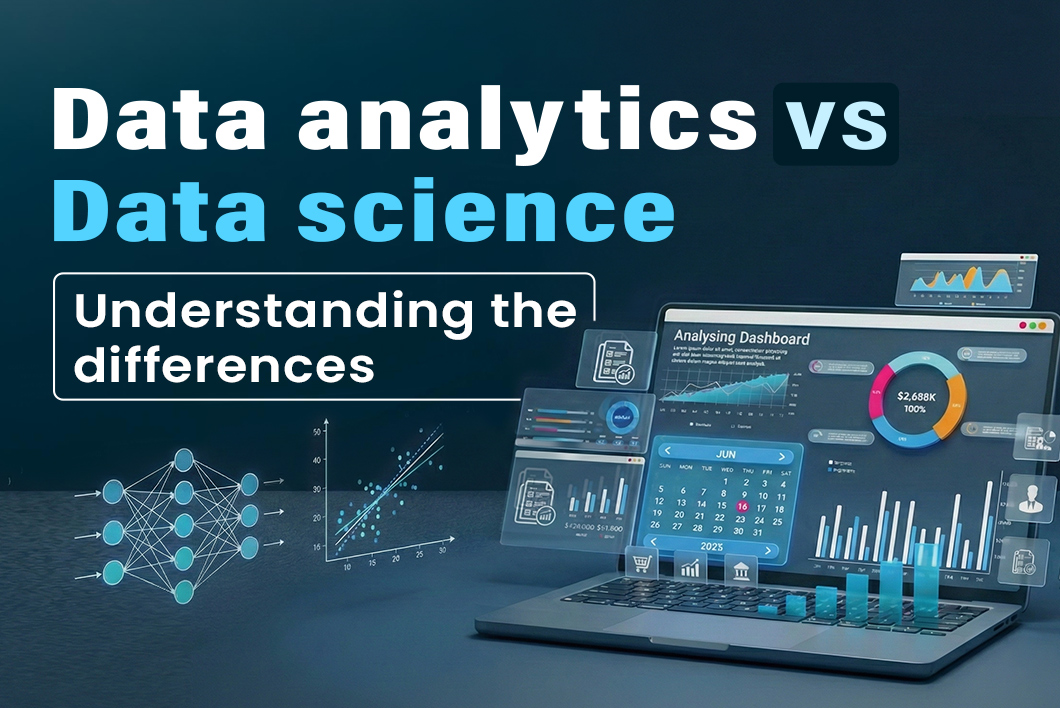

Data Analytics vs Data Science: Understanding the Difference
In today's data-driven world, two terms frequently appear in job postings, academic programs, and business discussions: data analytics and data science. Often used interchangeably, these fields are related but distinct, each with its own focus, methodologies, and career paths. If you're considering a career in data or trying to understand which skills your organization needs, understanding the difference between data analytics and data science is essential. Let's unravel this confusion and explore what makes each field unique.
The Core Distinction: Questions vs Discovery
At the heart of the difference lies the nature of the problems each field addresses and the approach taken to solve them.
Data Analytics is primarily about answering specific questions. Organizations have clearly defined problems they need to solve or metrics they want to understand. Data analysts examine existing data to find answers, identify trends, and provide insights that inform business decisions. The focus is on understanding what happened, why it happened, and what might happen based on historical patterns.
Data Science is more exploratory and predictive. Data scientists don't just answer predefined questions—they discover new questions worth asking. They build models to predict future outcomes, develop algorithms to solve complex problems, and create data products that generate ongoing value. The focus extends beyond understanding the past to building systems that automate decision-making and generate predictions.
Think of it this way: if a business asks "Why did sales drop last quarter in the Northeast region?" a data analyst would investigate. If the question is "Can we predict which customers are likely to churn in the next six months and automatically target them with retention offers?" that's where a data scientist comes in.
Scope and Complexity: Tactical vs Strategic
The scope of work differs significantly between these roles, reflecting their different objectives and the complexity of problems they tackle.
Data analysts typically work with structured data—information neatly organized in databases and spreadsheets. Their analyses focus on specific business questions with relatively clear parameters. They might analyze sales data to identify top-performing products, examine website traffic to understand user behavior, or evaluate marketing campaign effectiveness. The work is crucial but generally bounded in scope.
Data scientists often work with both structured and unstructured data—text, images, video, sensor readings, and complex datasets that require significant processing before analysis is possible. They tackle open-ended problems that might not have obvious solutions. Building a recommendation engine, developing fraud detection algorithms, creating predictive maintenance systems, or extracting insights from millions of customer reviews all fall under data science.
The strategic versus tactical distinction is important. Data analysts provide tactical insights that inform immediate decisions—which products to stock, where to allocate marketing budget, which customer segments to target. Data scientists build strategic capabilities that transform how organizations operate—automating processes, creating new products, or fundamentally changing business models.
Tools and Techniques: Reporting vs Machine Learning
The technical toolkits of data analysts and data scientists overlap but have important differences reflecting their different focuses.
Data analysts rely heavily on tools designed for data manipulation, visualization, and statistical analysis. SQL is fundamental for querying databases. Excel remains surprisingly powerful for analysis and widely used in business contexts. Visualization tools like Tableau, Power BI, or Looker help communicate findings effectively. Statistical software like R or Python with libraries like pandas is common for more sophisticated analysis. The emphasis is on extracting insights from data and communicating them clearly.
Data scientists need a broader and deeper technical toolkit. While they use many of the same tools as analysts, they also employ machine learning algorithms, deep learning frameworks, and advanced statistical methods. Python is the lingua franca, with libraries like scikit-learn, TensorFlow, and PyTorch for building models. They write more complex code, often developing production-ready software rather than one-off analyses. They need to understand algorithms deeply—not just how to use them, but how they work and when to apply them.
The distinction extends to methodology. Data analysts primarily use descriptive and diagnostic analytics—summarizing data, identifying patterns, and explaining why things happened. They employ statistical techniques but typically focus on hypothesis testing, correlation analysis, and trend identification.
Data scientists employ predictive and prescriptive analytics. They build models that forecast future outcomes—predicting customer behavior, anticipating equipment failures, or estimating demand. They go further into prescriptive analytics, developing systems that not only predict what will happen but recommend or automatically implement actions. This requires expertise in machine learning, optimization algorithms, and often deep learning for complex problems.
Educational Background: Foundation vs Specialization
The educational paths for these fields reflect their different technical demands and problem-solving approaches.
Data analysts typically need strong foundations in statistics, business analysis, and data manipulation. Many successful analysts have backgrounds in business, economics, mathematics, or social sciences. The barrier to entry is lower than data science, making it an accessible entry point into data careers. Bootcamps and online courses can effectively prepare people for analyst roles, especially when combined with domain expertise in a particular industry.
Data scientists generally need more advanced technical training. Many have graduate degrees in computer science, statistics, mathematics, or related quantitative fields. The role requires deeper mathematical understanding—linear algebra, calculus, probability theory—that underpins machine learning algorithms. While bootcamps and self-study can prepare people for data science roles, the learning curve is steeper and the competition more intense.
However, these distinctions are blurring. As analytics becomes more sophisticated, analysts are learning machine learning. As data science tools become more accessible, the barrier to entry is lowering. The fields are converging in some ways, with "data analyst" and "data scientist" sometimes describing similar roles depending on the organization.
Problem-Solving Approach: Past vs Future
The temporal focus of these roles highlights another key difference in how they approach problems.
Data analysts primarily work with historical data to understand past performance and current state. They create dashboards tracking key performance indicators, generate reports on business metrics, and conduct ad-hoc analyses to answer specific questions. Their work helps organizations understand their current position and recent trends. When they make predictions, it's typically through extrapolation of historical patterns—if sales grew 10% annually for five years, project similar growth forward.
Data scientists focus on the future, building models that predict outcomes based on patterns too complex for simple extrapolation. They don't just report what happened—they forecast what will happen and often build systems that act on those predictions automatically. A data scientist might develop a model that predicts customer lifetime value, enabling the company to adjust acquisition spending in real-time based on predicted future revenue rather than historical averages.
This difference shapes the deliverables. Analysts produce reports, dashboards, and presentations that inform human decision-makers. Scientists produce algorithms, models, and often production systems that operate autonomously or with minimal human oversight.
Business Impact: Insights vs Products
How these roles create value for organizations differs in important ways.
Data analysts drive value through insights that improve decision-making. Their work helps businesses understand performance, identify opportunities, spot problems, and make evidence-based decisions. An analyst might discover that customers acquired through social media have 30% higher lifetime value than those from paid search, leading to reallocation of marketing budget. The impact is real and measurable, but it requires humans to act on the insights.
Data scientists often create data products—automated systems that generate ongoing value. A recommendation engine that suggests products to millions of customers, a fraud detection system that automatically flags suspicious transactions, or a dynamic pricing algorithm that adjusts prices based on demand are all data products. These create value continuously and at scale, often with minimal human intervention once deployed.
The leverage differs significantly. An analyst's insights might influence decisions affecting thousands or millions of dollars. A data scientist's model might automatically make millions of decisions optimizing billions of dollars in transactions. Both are valuable, but the scale and automation differ.
Career Trajectories: Different Paths to Impact
Understanding these fields helps chart career paths aligned with your interests and strengths.
Data analyst roles offer excellent entry points into data careers. The learning curve is manageable, job opportunities are abundant, and the work directly impacts business outcomes. Analysts often specialize in particular business functions—marketing analytics, financial analysis, operations analytics—combining data skills with deep domain expertise. Career progression might lead to senior analyst roles, analytics management, or business intelligence leadership. Some analysts transition into data science as they develop more technical skills.
Data scientist roles typically require more technical depth but offer different opportunities. The work is often more technical and research-oriented, appealing to those who enjoy algorithm development and model building. Career paths might lead to senior data scientist positions, machine learning engineering, AI research, or technical leadership roles. Data scientists often specialize in particular techniques—natural language processing, computer vision, reinforcement learning—or industries like healthcare, finance, or autonomous systems.
Compensation reflects these differences. Data scientist salaries generally exceed analyst salaries, reflecting the more specialized skills and higher barrier to entry. Entry-level data analysts might earn $60,000–$80,000, while entry-level data scientists often start at $90,000–$120,000. However, skilled senior analysts in specialized domains can command salaries comparable to mid-level data scientists.
Real-World Scenarios: Seeing the Difference in Action
Concrete examples illuminate how these roles differ in practice.
E-commerce Company Scenario:
Data Analyst Task: Analyze why conversion rates dropped 5% last month. The analyst examines traffic sources, user behavior flows, checkout abandonment rates, and identifies that a recent website update caused slower page load times on mobile devices, leading to abandonments. They create a report with visualizations showing the correlation and recommend reverting the change.
Data Scientist Task: Build a product recommendation system that suggests items based on browsing behavior, purchase history, and similarities to other customers. The scientist develops collaborative filtering algorithms, tests multiple approaches, evaluates performance through A/B testing, and deploys a system that automatically generates personalized recommendations for millions of users.
Healthcare Organization Scenario:
Data Analyst Task: Analyze patient readmission data to identify patterns. The analyst discovers that elderly diabetic patients living alone have significantly higher 30-day readmission rates. They create dashboards tracking readmissions by demographic and clinical factors, enabling care coordinators to target high-risk patients for follow-up.
Data Scientist Task: Develop a predictive model that identifies patients at high risk of readmission at discharge time. The scientist builds a machine learning model incorporating dozens of clinical variables, demographic factors, and social determinants of health. The model generates risk scores that automatically trigger interventions—scheduling follow-up appointments, arranging home care, or initiating medication management programs.
Manufacturing Company Scenario:
Data Analyst Task: Investigate why defect rates increased in a particular production line. The analyst examines production data, identifies that defects correlate with a specific shift and particular equipment settings, and recommends process adjustments and additional training for that shift.
Data Scientist Task: Create a predictive maintenance system that forecasts equipment failures before they occur. The scientist analyzes sensor data from machinery, builds models recognizing patterns that precede failures, and deploys a system that alerts maintenance teams to service equipment proactively, reducing unplanned downtime.
The Overlap: A Spectrum, Not a Binary
While we've drawn clear distinctions, reality is messier. These fields exist on a spectrum, and many professionals work in the gray area between them.
Many "data scientist" roles at smaller companies are actually advanced analytics positions, focusing more on business analytics than machine learning. Conversely, "senior data analyst" roles at tech companies might involve significant predictive modeling and experimentation more typical of data science.
The trend is toward convergence. Analysts are learning machine learning as tools become more accessible. Scientists are developing stronger business acumen as organizations demand practical impact. Hybrid roles like "analytics scientist" or "machine learning analyst" are emerging.
Your title matters less than the work you do and skills you develop. Someone titled "data analyst" who builds predictive models and deploys automated systems is doing data science work. Someone titled "data scientist" who primarily creates dashboards and reports is doing analytics work.
Which Path Is Right for You?
Choosing between data analytics and data science depends on your interests, strengths, and career goals.
Consider data analytics if you:
• Enjoy solving concrete business problems with clear questions
• Like communicating insights to non-technical stakeholders
• Prefer working with business teams and directly impacting decisions
• Want to combine data skills with domain expertise in a particular industry
• Are looking for an accessible entry into data careers
• Enjoy the detective work of investigating why things happened
Consider data science if you:
• Enjoy building systems and algorithms more than conducting analyses
• Like tackling open-ended problems without obvious solutions
• Are comfortable with ambiguity and experimentation
• Have strong programming skills or willingness to develop them
• Are interested in machine learning, AI, and predictive modeling
• Want to create automated systems that generate ongoing value
Remember that these aren't permanent choices. Many data scientists started as analysts, developing technical skills over time. The fields are fluid, and continuous learning is expected in both.
The Skills You Need
Regardless of which path you choose, some skills are universally valuable:
Foundational skills for both:
• Statistical thinking and probability
• SQL and database querying
• Data visualization and communication
• Programming fundamentals (Python or R)
• Business acumen and domain knowledge
• Critical thinking and problem-solving
Additional emphasis for analysts:
• Excel and spreadsheet proficiency
• Business intelligence tools (Tableau, Power BI)
• Presentation and storytelling
• Stakeholder management
• Industry-specific knowledge
Additional emphasis for scientists:
• Machine learning algorithms and theory
• Deep learning frameworks
• Software engineering practices
• Mathematics (linear algebra, calculus)
• Experimentation and A/B testing
• Model deployment and MLOps
The Future: Evolving Together
As technology advances, both fields are evolving. AutoML tools are democratizing machine learning, enabling analysts to build predictive models without deep technical expertise. Low-code/no-code platforms are making data science accessible to broader audiences. Meanwhile, the growing complexity of data and sophistication of business problems pushes analysts toward more advanced techniques.
The line between these roles will likely continue blurring. What matters most isn't your title but your ability to extract value from data, solve problems that matter, and communicate insights that drive action. Whether you call yourself an analyst or a scientist, the goal is the same: turning data into decisions and decisions into outcomes.
Your Journey Starts Here
Both data analytics and data science offer rewarding careers with strong demand and excellent compensation. They provide opportunities to impact organizations across every industry and solve problems that matter. The "right" choice depends on your unique combination of interests, skills, and career aspirations.
The good news? You don't have to choose immediately. Start with analytics to build foundations, then specialize based on what excites you. Or dive straight into data science if you have strong technical backgrounds and clear interests. Many successful data professionals have meandering paths, gaining diverse experience before finding their specialty.
The most important step is simply to start—learning, building projects, and developing skills. The data revolution is just beginning, and there's room for everyone willing to join. Whether you're answering yesterday's questions or building tomorrow's predictions, you'll be part of transforming how organizations understand and act on information.
The future belongs to those who can turn data into wisdom. Will you be a data analyst, a data scientist, or something entirely your own? The only way to find out is to begin.
Ready to launch your data career? Explore our programs in Data Analytics and Data Science—where comprehensive curriculum meets hands-on experience to prepare you for high-demand careers in data.



 How can I help you?