

What Happens Inside a Python Training Session?
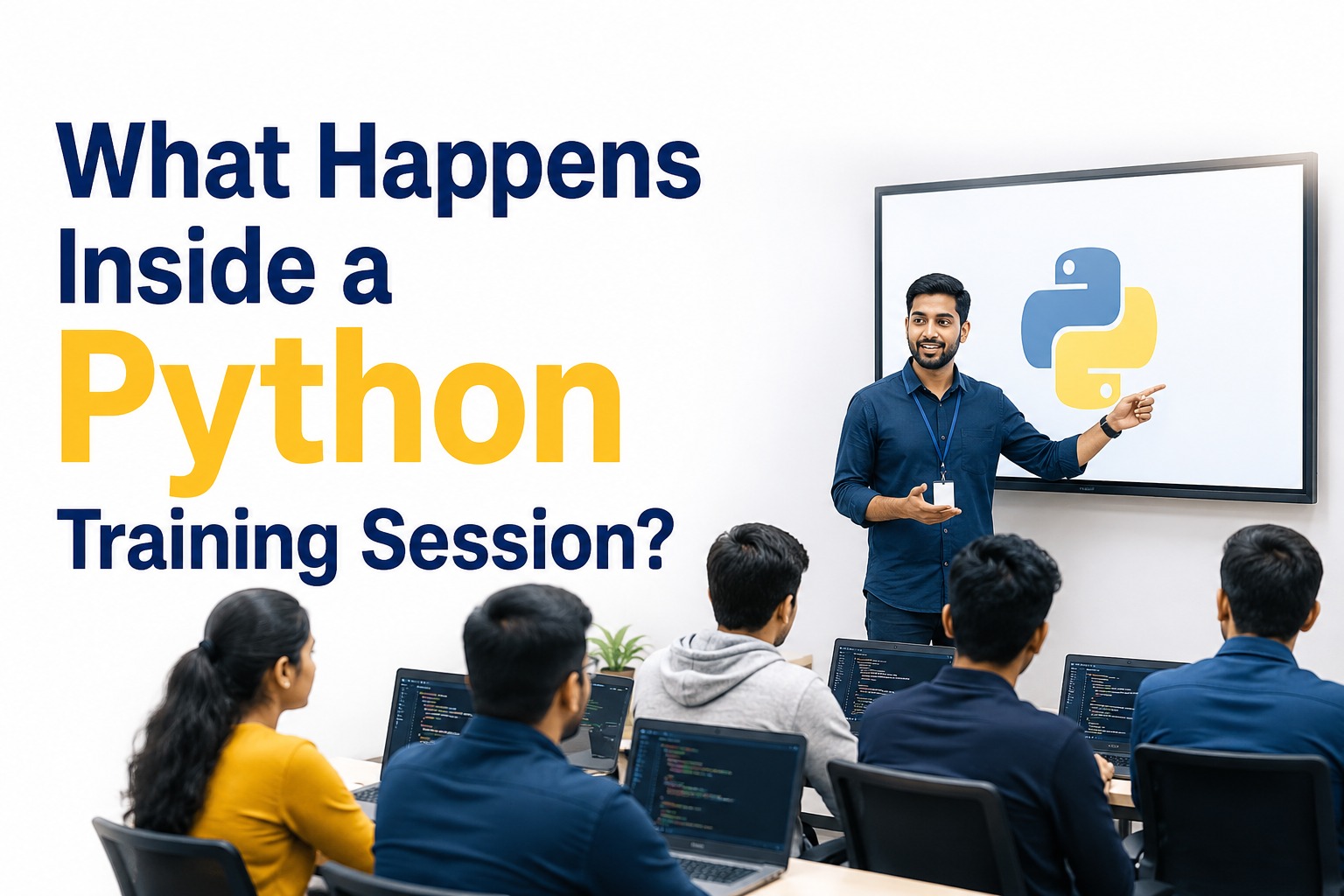
Thinking about learning Python, but unsure what actually happens inside a classroom?
Many beginners worry about whether coding will be difficult or confusing. The truth is, a good Python course for beginners is designed to make learning simple, practical, and beginner-friendly.
Modern training programs focus less on theory and more on hands-on learning. Students learn by watching live coding, practicing programs, solving exercises, and building small projects step by step.
In this blog, let’s explore what a typical Python learning session looks like and how beginners gradually build confidence in coding.
How a Typical Python Training Session Starts
Most sessions follow a structured and easy-to-understand format that helps students learn comfortably.
✔ Concept Explanation
Every class usually begins with a simple explanation of the topic. Trainers use real-world examples instead of complicated technical language.
For example, concepts like variables or loops are explained using everyday situations, making programming easier to understand.
✔ Live Coding by Trainer
Instead of only teaching theory, trainers write code live in front of students.
This helps learners understand how programs are created, how errors happen, and how coding logic works in real time.
✔ Student Practice Time
After demonstrations, students practice coding on their own systems.
They work on exercises, small tasks, and logic-building activities related to the topic covered in class.
✔ Doubt Clearing
One of the best parts of classroom learning is immediate support. Students can ask questions anytime, and trainers help solve errors or confusion instantly.
This interactive style makes learning much smoother for beginners.
What You Will Learn in Python Sessions
Python training usually starts with fundamentals and gradually moves toward practical applications.
Some common topics include:
. Variables and data types
. Loops and conditional statements
. Functions
. Lists and dictionaries
. Basic problem-solving logic
. File handling concepts
The focus is always on understanding how coding works rather than memorizing syntax.
Students also learn how Python is used in real-world applications like automation, web development, data handling, and software development.
Practical Learning – The Most Important Part
A quality coding course is never just about theory.
Practical learning is a major part of every session. Students regularly write programs, test outputs, and correct mistakes themselves.
Hands-on activities may include:
. Small coding exercises
. Logic-building tasks
. Debugging practice
. Real-time programming activities
This practical approach helps students improve confidence and become comfortable with coding naturally.
It also makes learning more engaging compared to simply reading notes or watching videos.
Python Mini Projects You Will Work On
Mini projects are where students start applying what they learn.
As concepts become clearer, trainers introduce beginner-friendly projects such as:
. Calculator application
. Number guessing game
. Student mark management system
. Password generator
. Simple billing software
Working on projects helps students understand how programming is used to create real applications.
Completing even a small project gives beginners a strong sense of achievement and motivates them to continue learning.
How Beginners Are Supported
One of the biggest fears students have is:
“What if I have no coding background?”
The good news is that most learners start from scratch.
Good training programs are designed to support beginners through:
. Step-by-Step Teaching
Topics are introduced slowly and clearly without overwhelming students.
. Simple Real-Life Examples
Programming concepts are connected with everyday examples to improve understanding.
. Personal Guidance
Trainers support students individually whenever they face difficulties.
. Continuous Practice
Regular exercise helps students strengthen their coding and logical thinking skills.
With the right guidance, even non-technical students can learn programming comfortably.
Tools Used in Python Training
Students are also introduced to basic development tools during the course.
. VS Code
A beginner-friendly code editor used for writing and running programs.
. Python Installation Setup
Students learn how to install Python and configure their systems properly.
. Basic Command Usage
Trainers explain simple commands needed for running files and managing programs.
The goal is to make students comfortable with the coding environment from the beginning.
How This Training Helps You Become Job-Ready
Learning Python is not only about understanding programming syntax.
A practical course helps students develop important career skills such as:
. Problem-solving ability
. Logical thinking
. Hands-on coding experience
. Project development skills
. Confidence in programming
Many training programs also include resume guidance, mock interviews, and placement assistance.
. Basic interview preparation
. Resume guidance
. Mock interview sessions
. Career support
This helps students prepare for entry-level opportunities in software development, automation, testing, data analytics, and related technology fields.
Who Should Join Python Training?
Python is one of the easiest programming languages to start with, which makes it suitable for different types of learners.
This course is ideal for:
. Beginners with no coding experience
. College students
. Fresh graduates
. Career switchers
. Job seekers
. Professionals looking to upgrade skills
Whether your goal is software development, data science, automation, or web development, Python can be a strong starting point.
Why Students Choose Camerinfolks
Many students prefer learning at Camerinfolks because of the practical and beginner-friendly learning environment.
The training approach focuses on helping students understand concepts through:
. Interactive coding sessions
. Practical exercises
. Real-time mini projects
. Supportive trainer guidance
. Step-by-step learning methods
Students often feel more confident when learning happens in a simple, practice-oriented environment rather than a purely theoretical one.
Ready to Start Your Python Journey?
Learning coding becomes easier when you start with the right guidance and practical support.
If you are planning to begin your programming journey, this is the perfect time to explore Python. Even complete beginners can learn coding step by step with consistent practice and proper mentorship.
Start With Confidence
. Talk to trainers before joining
. Get guidance on the right learning path
. Attend beginner-friendly practical sessions
. Build coding skills through hands-on projects
If you’ve been waiting to start learning programming, don’t keep postponing it.
Take the first step today and begin your journey into the world of Python development.
Still confused? Talk to our trainers and get free guidance before joining.
Frequently Asked Questions
1. What happens in a Python training session?
A typical session includes concept explanation, live coding demonstrations, practical exercises, doubt clearing, and mini project work.
2. Is Python training difficult for beginners?
No. Python is considered one of the easiest programming languages for beginners because of its simple syntax and practical learning approach.
3. Do I need coding experience to join a Python course?
No prior programming knowledge is required. Most courses are designed for complete beginners.
4. What topics are covered in Python classes?
Topics usually include variables, loops, conditions, functions, lists, dictionaries, file handling, and mini projects.
5. Can Python training help me get a job?
Yes. Practical training helps students develop coding skills, build projects, improve confidence, and prepare for entry-level IT opportunities.


 How can I help you?