
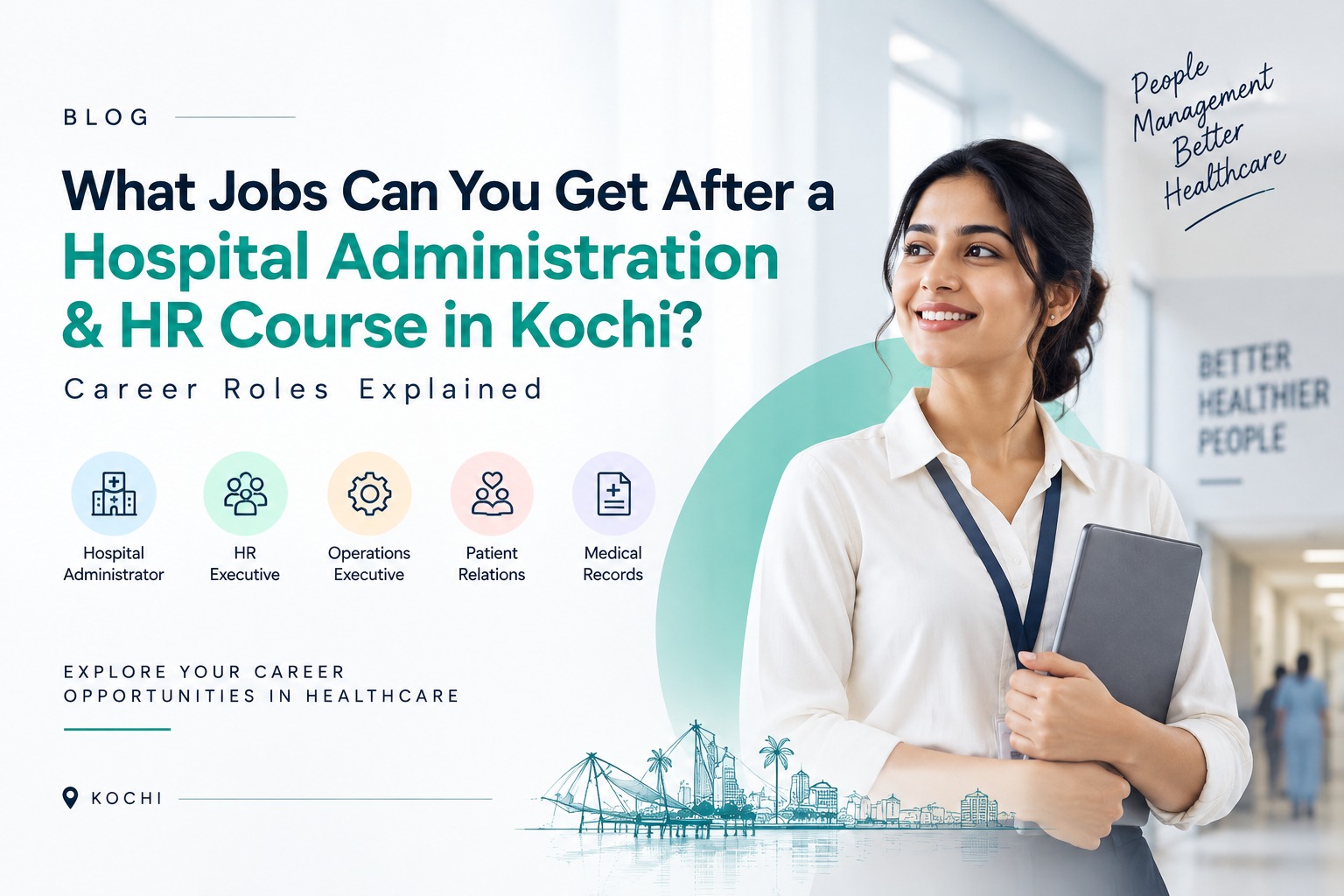


What Jobs Can You Get After a Hospital Administration & HR Course in Kochi? Career Roles Explained
If you are searching for Human Resource courses in Kochi, you may already know that HR can be a promising career path. But there is one practical question that usually comes before enrolling in a course:
“What job can I actually get after completing it?”
That is especially important when you are considering a combined Hospital Administration & HR course. Unlike a purely theoretical HR program, this type of training can introduce you to both healthcare operations and human resource functions.
For graduates and career switchers in Kochi, understanding the possible job roles, required skills and career progression can make it much easier to decide whether this path is right for you.
In this guide, we will look at the common career roles associated with Hospital Administration and HR training, the skills employers may expect, and how these skills can be useful beyond the healthcare sector.
What Does a Hospital Administration & HR Course Actually Prepare You For?
A Hospital Administration & HR program combines two closely connected areas: healthcare operations and people management.
Modern hospitals are not managed only by doctors and nurses. Behind patient care, there are teams handling admissions, appointments, front-office operations, staff coordination, recruitment, payroll, insurance, medical records, billing and other administrative processes.
Camerin's Hospital Administration & HR program, for example, covers areas such as hospital operations, IPD and OPD management, front-office functions, recruitment, staff training, payroll, performance evaluation, medical insurance and claims, financial management and material management. The program also includes training related to hospital management software.
A Blend of Healthcare Operations and HR Skills
Students can develop an understanding of:
* Hospital administration and healthcare systems
* Patient registration and appointment handling
* IPD and OPD workflows
* Front-office operations
* Recruitment and staff coordination
* Employee records and payroll
* Training and performance evaluation
* Insurance and TPA coordination
* Billing and administrative processes
* Communication and public interaction
This combination can be useful for people who want to work in healthcare administration as well as those interested in HR-related positions.
How Is It Different From a Pure HR Course?
A general HR course primarily focuses on people-related functions such as recruitment, employee engagement, payroll, training and performance management.
A Hospital Administration & HR course adds healthcare-specific operational knowledge to those HR fundamentals.
That means a graduate may understand not only how HR processes work, but also the environment in which healthcare employees operate.
For someone interested in healthcare organizations, that additional context can be valuable.
Common Job Roles After a Hospital Administration & HR Course
One of the biggest advantages of learning both administration and HR is that your career options are not limited to a single job title.
Depending on your qualifications, practical experience, communication skills, and employer requirements, you may explore different entry-level roles.
1. Hospital Operations Executive
Hospital Operations Executives support the day-to-day functioning of healthcare facilities.
Their responsibilities may include coordinating departments, supporting patient-flow processes, handling administrative activities and communicating with different teams.
This can be a suitable starting point for graduates interested in the operational side of healthcare.
2. HR Coordinator
An HR Coordinator supports everyday HR activities within an organization.
Typical responsibilities can include:
* Maintaining employee records
* Supporting recruitment activities
* Coordinating interviews
* Managing documentation
* Assisting with on boarding
* Supporting employee communication
In a hospital environment, the role may also involve coordinating staffing requirements and maintaining employee-related information.
3. Front Office Manager or Executive
Front-office teams are often the first point of contact for patients and visitors.
Depending on the organization and level of responsibility, front-office professionals may handle:
* Patient registration
* Appointment coordination
* Enquiries
* Communication
* Documentation
* Department coordination
Strong communication and interpersonal skills are particularly important for these roles.
4. Medical Records Officer
Medical records professionals help maintain and organize patient-related documentation.
The role requires attention to detail, data-handling skills and an understanding of administrative processes within healthcare organizations.
As hospitals increasingly rely on digital systems, familiarity with healthcare software can also be useful.
5. Healthcare Administrator
Healthcare Administrators support the administrative functioning of hospitals, clinics and other healthcare organizations.
The responsibilities can vary depending on the organization, but may include coordination between departments, administrative documentation, staff coordination and operational support.
Camerin specifically lists Healthcare Administrator among the potential career opportunities associated with its Hospital Administration & HR program.
6. Patient Relations Officer
Patient Relations Officers focus on communication and coordination with patients.
They may help address enquiries, coordinate services and ensure that patients receive appropriate information about administrative processes.
This role can be particularly suitable for candidates who enjoy working with people and have strong communication skills.
7. Insurance or TPA Coordinator
Healthcare organizations regularly deal with insurance and third-party administrator processes.
An Insurance or TPA Coordinator may assist with documentation, claims-related coordination and communication between patients, hospitals and insurance-related parties.
Training in medical insurance and claims can therefore be useful for candidates interested in this area. Camerin's curriculum includes medical insurance, claims handling and TPA coordination.
8. Healthcare HR Executive or Recruiter
Hospitals and healthcare organizations need people to recruit, coordinate and manage employees across different departments.
Healthcare HR roles can involve:
* Recruitment
* Interview coordination
* Employee documentation
* Staff training
* Payroll support
* Performance evaluation
* Employee communication
This is where the combination of HR knowledge and healthcare-sector understanding can become particularly relevant.
Is This Course Only Useful for Healthcare Careers?
No.
One of the common concerns among students considering Human Resource courses in Kochi is whether specializing in hospital administration will restrict them to hospitals.
The answer is that many HR skills are transferable.
Recruitment, employee documentation, communication, onboarding, payroll coordination, performance management and employee engagement are relevant across many industries.
For example, a candidate who develops strong HR fundamentals through a healthcare-focused program may later explore HR opportunities in:
* Healthcare organizations
* Clinics and diagnostic centres
* Corporate offices
* Service organizations
* Recruitment companies
* Other organizations with HR departments
However, the exact eligibility for a particular position depends on the employer, educational qualification, experience and job description.
The healthcare specialization can therefore be viewed as an additional area of knowledge, rather than a restriction.
What's the Difference Between HR Roles and Hospital Administration Roles?
Although these areas overlap, their primary focus is different.
| HR-focused roles | Hospital Administration roles |
| Recruitment | Hospital operations |
| Employee records | Patient coordination |
| Payroll support | Front-office operations |
| Training | Department coordination |
| Performance management | Medical records |
| Employee engagement | Insurance/claims coordination |
| Staff communication | Administrative support |
There are also roles where these responsibilities overlap.
For example, a healthcare HR professional may need to understand hospital staffing requirements, shift management and healthcare-specific workforce challenges.
That is one reason Hospital Administration & HR Courses in Kochi can be attractive to students who want exposure to both areas.
Skills You'll Build That Employers Look For
Completing a course alone does not guarantee a particular job. Employers generally look at a combination of education, practical knowledge, communication, confidence and role-specific skills.
A good training program should therefore focus on more than classroom theory.
Administrative Skills
Students can develop familiarity with:
* Hospital workflows
* Patient coordination
* Appointment handling
* Documentation
* Billing processes
* Insurance coordination
* Department coordination
* Basic financial and material management
HR Skills
HR-focused learning can include:
* Recruitment
* Staff training
* Employee records
* Payroll
* Performance evaluation
* Manpower coordination
* Employee communication
Communication Skills
Administration and HR are both people-oriented functions.
Professionals regularly communicate with patients, employees, managers, doctors, vendors and other stakeholders.
That makes professional communication an important part of career preparation.
Practical and Software Exposure
Camerin's program emphasizes practical, scenario-based learning and integrated system training. Its course information also highlights areas such as patient data management, billing, insurance processing, staff scheduling and recruitment using healthcare management software.
This kind of exposure can help students understand how administrative concepts are applied in real working environments.
Camerin also provides internship opportunities designed to give students real-world exposure and help them transition classroom knowledge into practical application.
Career Growth After Entry-Level Roles
Most careers do not begin with a managerial position.
A more realistic way to look at Hospital Administration and HR is as a progression.
For example:
Entry-Level Executive → Coordinator → Senior Executive → Supervisor/Manager → Senior Management
The exact progression depends on the organization, performance, experience and additional qualifications.
Someone starting as an HR Coordinator may gradually move toward HR Executive, Senior HR Executive or HR management responsibilities.
Similarly, someone beginning in hospital operations may progress into coordination, supervisory and operations-management positions as they gain experience.
The important point is to focus on building practical skills and industry experience, rather than choosing a course only because of a particular job title.
Hospital Administration & HR Careers in Kochi and Kerala
Kochi is an important education, business and healthcare hub in Kerala, making it a natural location for students interested in healthcare administration and HR careers.
The local healthcare ecosystem includes hospitals, clinics, diagnostic centres and other healthcare-related organizations. At the same time, Kochi's wider corporate environment creates opportunities for HR and administrative professionals across different sectors.
For someone searching for a hospital administration course institute in Kochi, location can therefore be one practical consideration — but it should not be the only one.
When comparing institutes, look at:
* Course curriculum
* Practical training
* Industry exposure
* Software training
* Internship opportunities
* Interview preparation
* Trainer experience
* Communication and soft-skill training
Camerin's Hospital Administration & HR program is offered in Kochi and includes practical learning, healthcare software exposure, HR training and additional preparation such as aptitude, group discussions, resume preparation, HR rounds, mock interviews and communication classes.
Frequently Asked Questions
What jobs can I get after a Hospital Administration & HR course?
Depending on your qualifications, skills and employer requirements, possible roles include Hospital Operations Executive, HR Coordinator, Front Office Executive/Manager, Medical Records Officer, Healthcare Administrator, Patient Relations Officer, Insurance Coordinator and healthcare HR/recruitment roles.
Is a Hospital Administration & HR course useful for HR roles outside healthcare?
Yes. Core HR skills such as recruitment, employee documentation, payroll support, training, performance evaluation and communication can be relevant across industries. Healthcare-specific knowledge can provide additional specialization, although individual job eligibility depends on the employer.
Do I need a medical background to study Hospital Administration?
Not necessarily. Camerin states that its Hospital Administration & HR program does not require specific prerequisites and is designed for both medical and non-medical backgrounds. Basic computer knowledge, communication skills and an interest in healthcare management or HR can be beneficial.
What skills do employers look for in HR and hospital administration graduates?
Employers may look for communication skills, administrative ability, computer literacy, attention to detail, teamwork, problem-solving and knowledge of relevant HR or healthcare processes. Practical exposure and interview readiness can also help candidates compete for entry-level opportunities.
How is this course different from a general HR course?
A general HR course primarily focuses on human resource functions. A Hospital Administration & HR course combines HR concepts with healthcare operations, patient coordination, hospital workflows, insurance and claims, front-office activities and healthcare administration.
Is HR a good career for non-commerce graduates?
Yes. HR is not limited to commerce graduates. Graduates from different academic backgrounds can explore HR when they develop the relevant skills, communication ability and practical knowledge required for the role.
What Should You Look For Before Choosing a Course?
If your goal is to build a career rather than simply earn a certificate, compare courses based on what you will actually learn and practice.
Ask yourself:
* Does the course cover both theory and practical applications?
* Will I learn how hospital administration actually works?
* Does the curriculum include relevant HR functions?
* Will I receive exposure to healthcare management software?
* Is there internship or practical exposure?
* Does the institute provide interview and placement assistance?
* These questions can help you distinguish between a course that simply provides information and one designed to improve your workplace readiness.
Build Your Career With Hospital Administration & HR Training in Kochi
Choosing a career course is a significant decision, especially when you are a fresh graduate or considering a career change.
A Hospital Administration & HR program can provide exposure to two important areas: healthcare operations and human resource management. From hospital operations and patient coordination to recruitment, payroll and employee management, the skills can support different career directions.
Camerin's Hospital Administration & HR course in Kochi combines healthcare administration, HR functions, practical scenarios and healthcare software training. The institute also provides internship and placement assistance as part of its career-support approach.
If you are still unsure which role suits your background, speaking with a career counsellor can help you understand the difference between HR, hospital administration and healthcare HR pathways before you enroll.


 How can I help you?